RTP in Crazy Time: what 96,08% means and why it matters
Crazy Time is often included in welcome offers, free bets, or loyalty promotions — the exact terms depend on the casino and your region. Below is the basic process to claim a bonus and avoid common restrictions.
 Legal casino (DGOJ)
Strategies review
Demo in browser
Legal casino (DGOJ)
Strategies review
Demo in browser
US 18+
Play responsibly
Only licensed operators
RTP in Crazy Time: what 96,08% means and why it matters
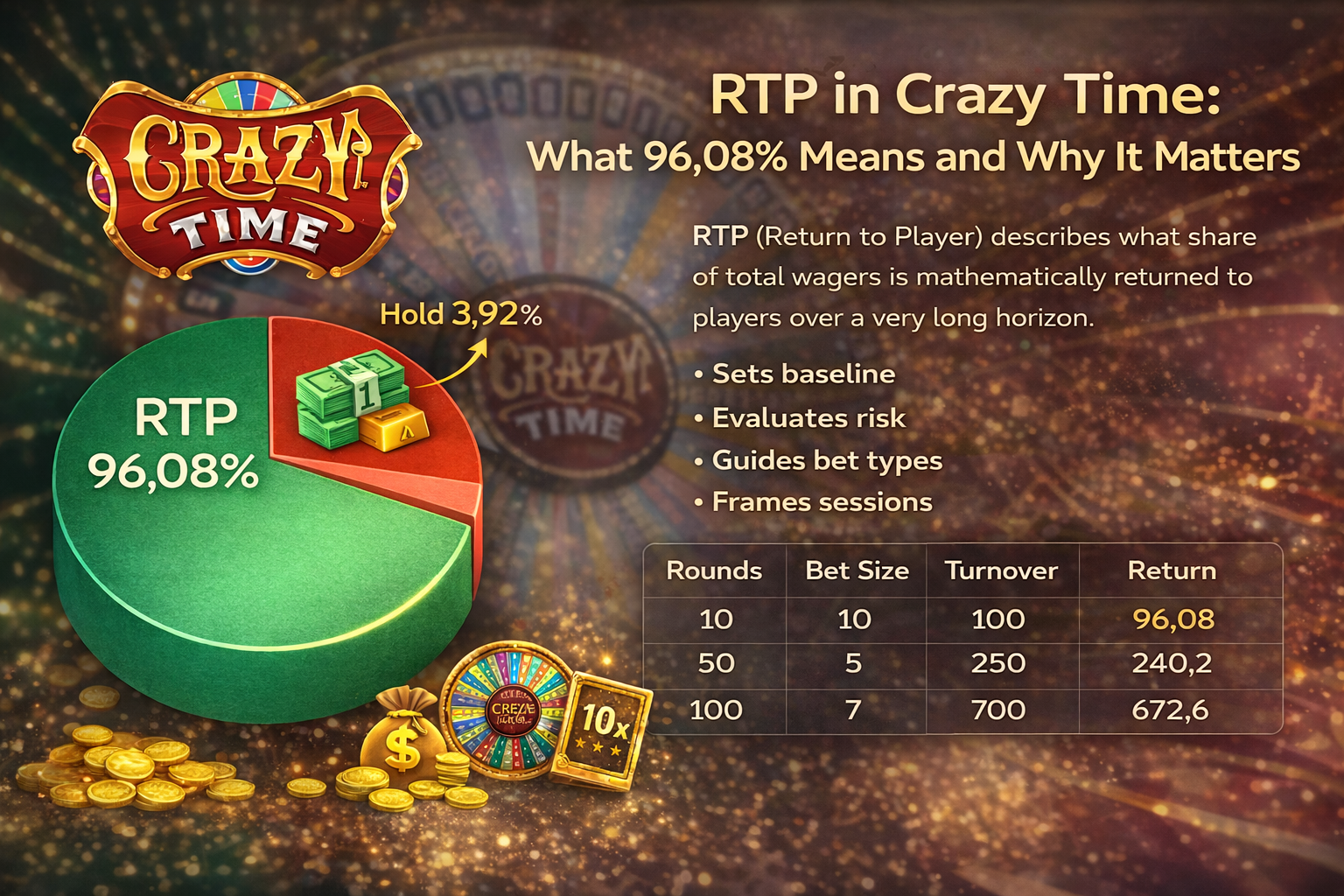
In wheel-of-fortune style games, RTP is often seen as a “slot thing.” In Crazy Time it works the same: RTP describes what share of total wagers is mathematically returned to players over a very long horizon. The figure 96,08% is often cited as an orientation for the base version, but exact values may vary depending on the game version and the operator. Understanding RTP helps you assess risk, choose bet types, and plan sessions more predictably.
Below we explain how RTP works in Crazy Time, why short-term results wander around theory, how different bet options feel, which myths to drop, and what is actually under player control.
What RTP means in Crazy Time
RTP (Return to Player) is the share of all stakes that, according to the math model, returns to players over the long run. If we take 96,08% as an orientation, the game’s theoretical “hold” is 3,92% of total turnover. It is not a forecast of your personal result for one evening but a property of the whole model across huge samples of rounds.
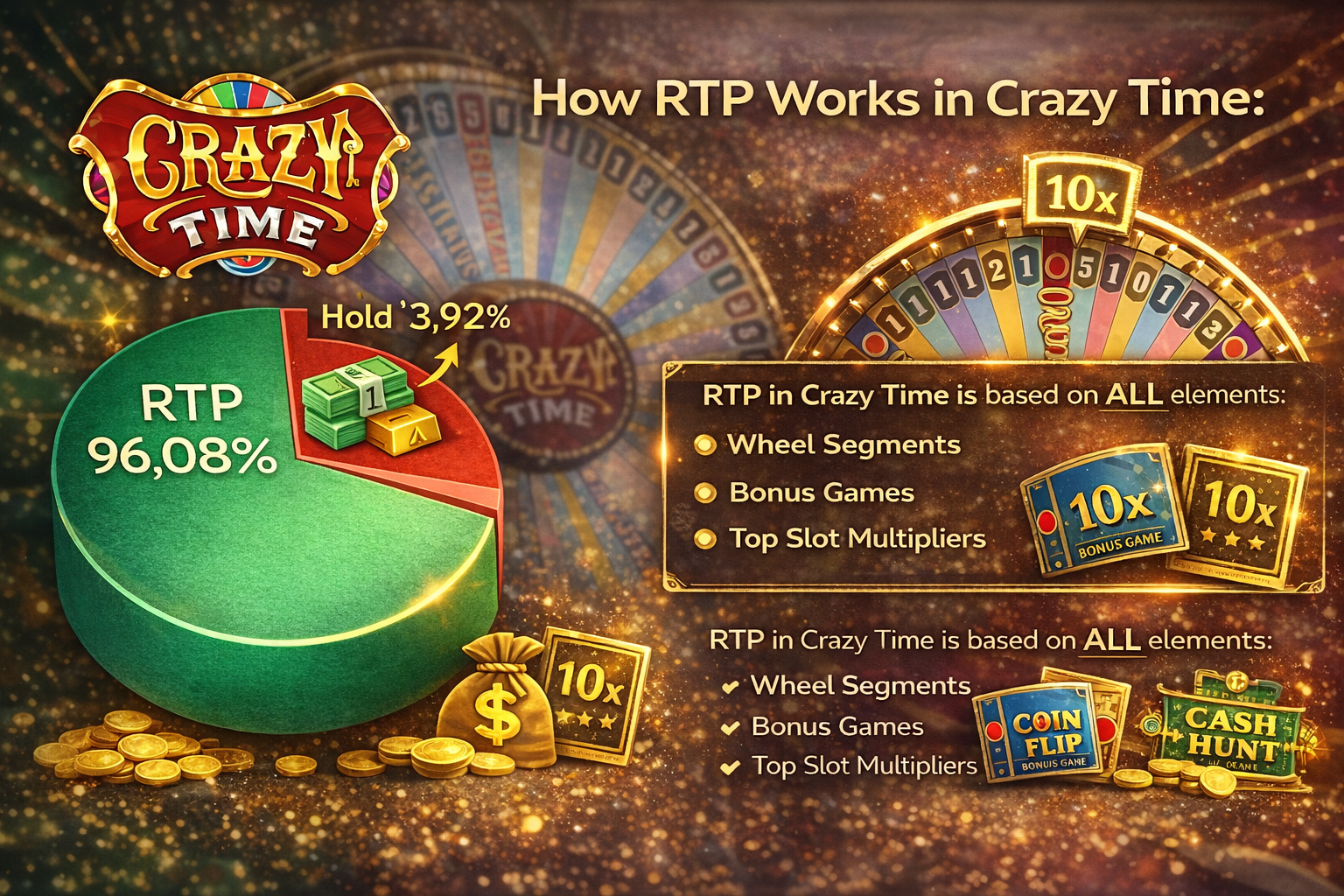
In Crazy Time, RTP is computed across all elements: the wheel with numbered segments, bonus games, and the Top Slot effect that can multiply payouts on specific bets. The exact configuration of segments, multipliers, and rules can differ, so exact values may vary depending on the game version and operator. RTP describes the average return, while the win distribution remains clumpy, which is why short sessions can be much better or worse than the average.
How RTP is formed: segments, bets, and Top Slot
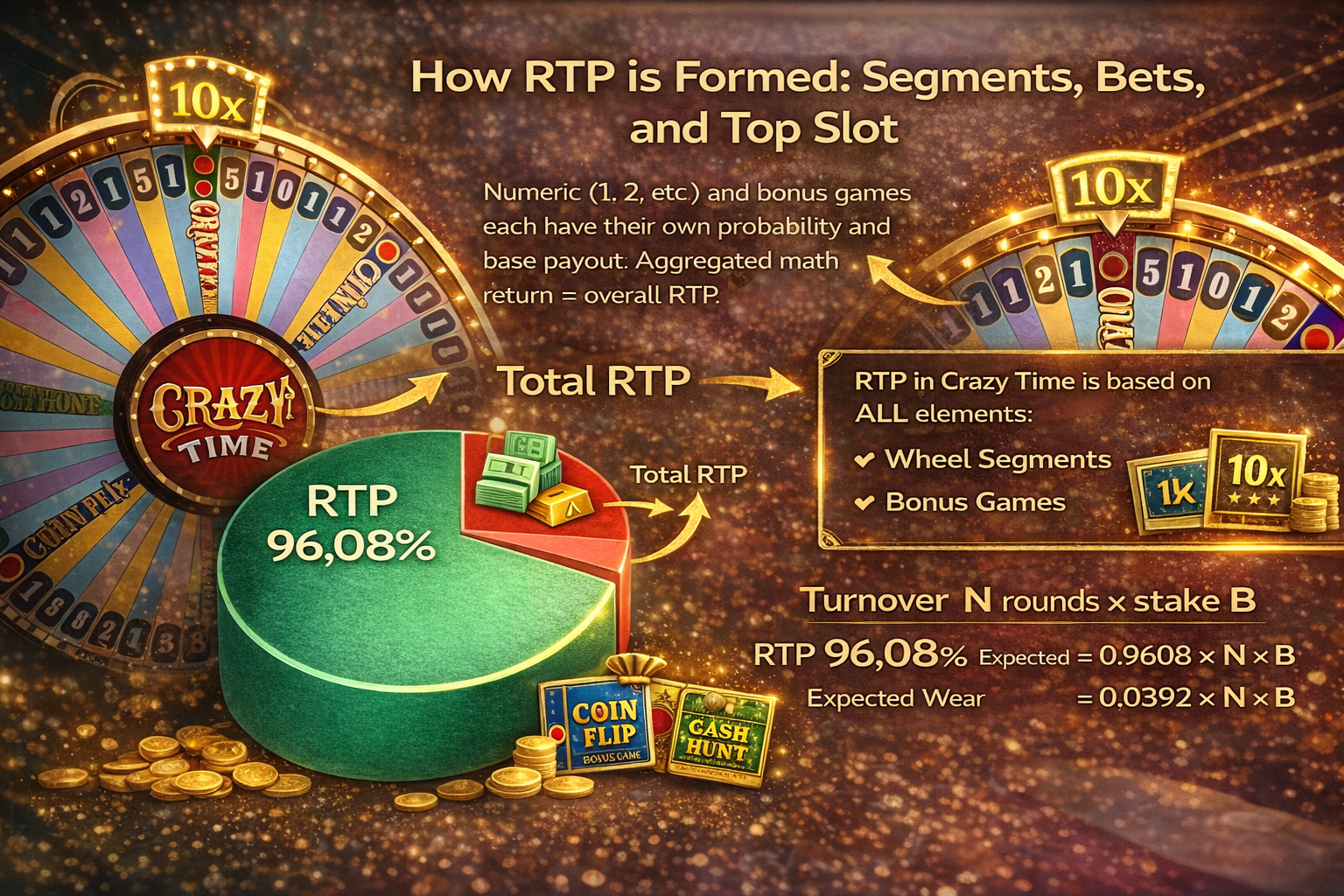
The wheel has several outcome types: numeric (1, 2, etc.) and bonus games. You choose which outcomes to cover. Each outcome has its own probability and base payout, and the model’s total mathematical return across all possible bets aggregates into overall RTP.
Top Slot is a separate mechanism that, before the wheel stops, may assign a multiplier to a specific sector. That changes the instantaneous potential payout but does not break the underlying theory: Top Slot is included in the RTP calculation. In certain versions/streams, the size and frequency of multipliers can differ, so exact values may vary depending on the game version and operator. Either way, the model keeps the intended long-run return.
Think in terms of turnover rather than “chance to land a big multiplier.” If you play N rounds at stake B, your turnover is N × B. With an RTP of 96,08%, the long-run expected return is about 0.9608 × N × B, while the expected “wear” of your bankroll is roughly 0.0392 × N × B. Short-term results will almost always deviate, which is normal.
RTP, variance, and hit frequency: why your session won’t look like the average
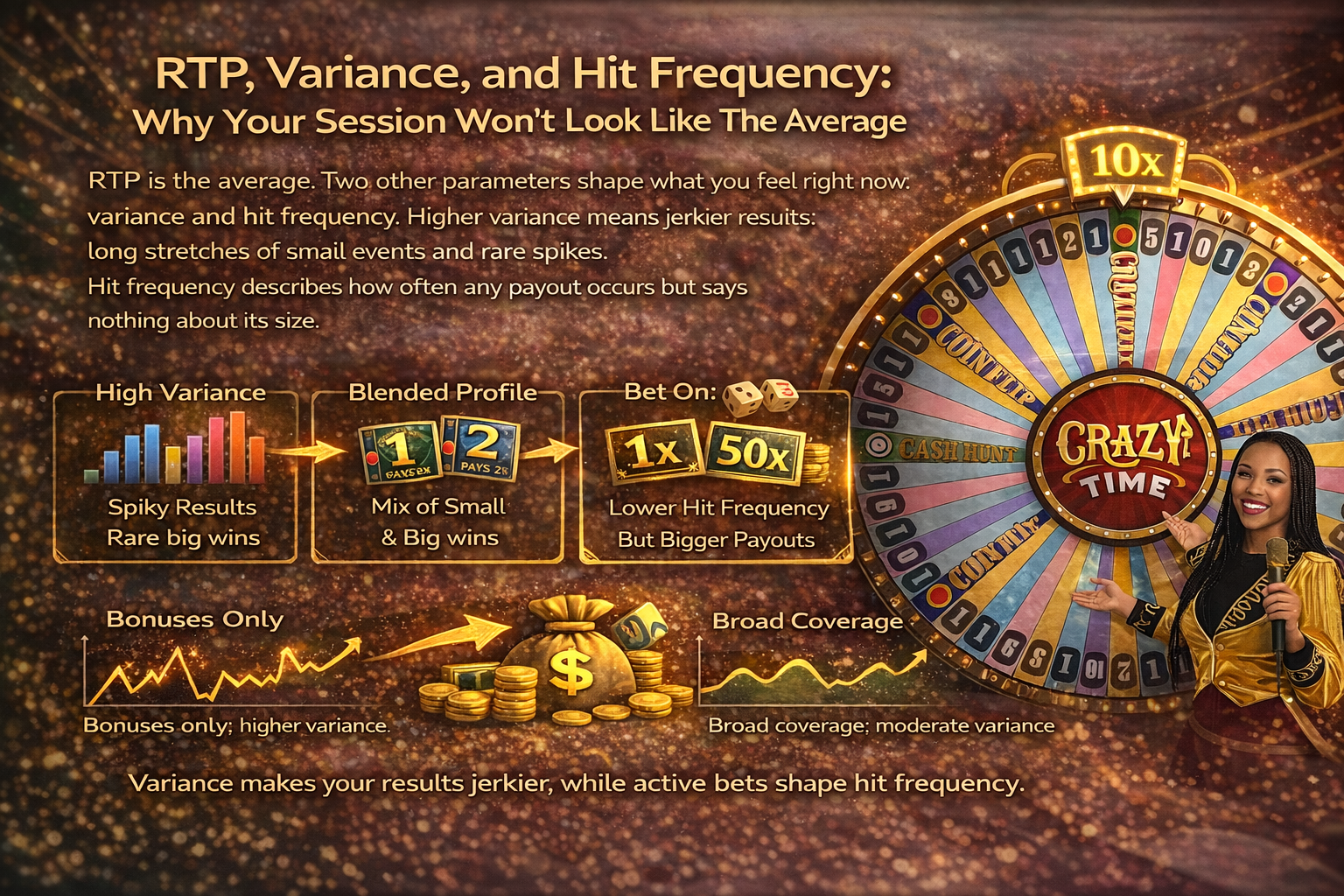
RTP is the average. Two other parameters shape what you feel right now: variance and hit frequency. Higher variance means jerkier results: long stretches of small events and rare spikes. Hit frequency describes how often any payout occurs but says nothing about its size.
Crazy Time mixes numeric sectors with bonus rounds, creating a blended profile. Bets on base numbers tend to hit more often but usually with lower payouts. Bonus games hit less frequently yet can deliver large multipliers. Two sessions with the same turnover may end very differently. That’s not the theory “failing”; long-run math smooths spikes and droughts, while randomness dominates short runs.
Selective coverage adds more spread. Many players bet only on bonuses, ignoring numbers. That increases local variance even though the overall game RTP remains the same. In practice, the narrower your coverage, the rougher your results will feel.
Differences between options and bet types
There is no single experience across all bets. Different outcomes have different probabilities and payouts, so their own theoretical return and risk profiles differ. Studios may update content and infrastructure providers may tune streams, so exact values may vary depending on the game version and operator.
In practice:
-
 Bets on base numbers typically create a smoother cash flow but with lower single-hit potential.
 -
Bets on bonus games create higher variance: long quiet periods and rare, large results.
-
Mixed approaches (several numbers plus one bonus) reduce variance relative to “bonuses only,” but long dry spells are still possible.
Don’t hunt for “the best RTP” at the sector level. Focus on the volatility you’re personally comfortable with. Long-run RTP will be similar, while the path of bankroll swings differs a lot.
Common misconceptions to drop
Misconceptions from slot play are common here too. A short list for quick reference:
| Myth | Reality |
|---|---|
| “RTP 96,08% means I’ll get 96,08% back today” | RTP is a model parameter over huge samples. Single sessions can deviate widely. |
| “Top Slot boosts the RTP on my bet” | It changes potential payout in that round, but its statistical impact is already in the overall math. |
| “After many misses, a bonus is due” | The wheel doesn’t track streaks. Each round is independent. |
| “If I cover everything, I beat the system” | You increase turnover. RTP applies to turnover, not unique events. Long-run result stays within the same return. |
| “Different skins mean different RTP” | Graphics don’t change math. Only configuration/version/stream matters. Exact values may vary depending on the game version and operator. |
These errors affect bet selection, session length, and mood. Losing the illusions makes decisions easier.
What you can control: limits, duration, demo, and bet structure
You can’t control the math, but you control your process. These are not platitudes; they change the actual experience.
Bankroll and limits Duration Bet structure Demo and simulators Pauses and tempo You control turnover and the variance of your own experience, not the global math.
UX and visual effects: don’t confuse emotion with math
Crazy Time presents each round like a mini-story: camera moves, host, animations, audio stingers, Top Slot focus, dynamic cuts to bonuses. It’s engaging, and it adds zero percent to the math.
Watch for:
- Round speed. Faster pace accelerates turnover and runs your limit quicker.
- Camera focus. Close-ups on Top Slot and “almost hits” amplify emotion. They are not signals.
- History panels. Past logs show “what happened,” not “what will happen.” Treat them as logs, not predictors.
Presentation is entertainment, not a reason to raise stakes or change coverage.
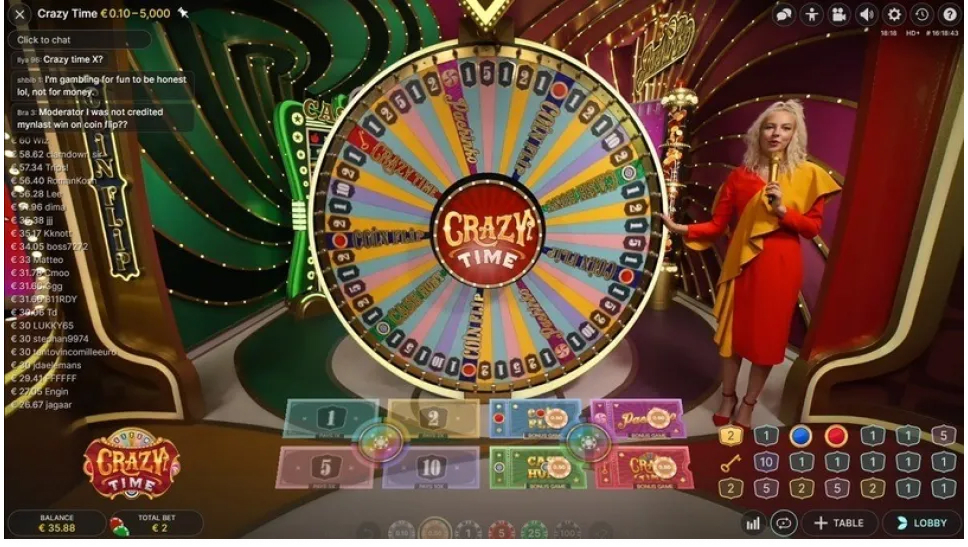
Performance and adaptability: stream, latency, and mobile UI
Since Crazy Time is live, connection quality affects perception. A stable stream reduces rushed clicks and missed bets due to lag. Mobile layout matters: on small screens you can mistap, mis-scale, or forget to remove chips.
Practical tips:
- Check latency. If your stream lags, you have less decision time. Simplify coverage to avoid rushing.
- Test on your device. Layout, gestures, and zoom affect speed and accuracy.
- Watch autobet. Autoplay speeds routine but also speeds turnover. Pre-estimate what 10–15 minutes of that pace costs.
Technical smoothness doesn’t change RTP but reduces user errors and turnover spikes, which is noticeable in real play.
How RTP’s role evolved: from slots to live shows
-
 RTP started as a “slot passport”: a fixed return percentage over huge spins. Live shows extended that idea. In Crazy Time, RTP depends on the mix of outcome types, bonus modes, and an external Top Slot modifier. Analytically it’s the same “expected share of return,” just on more complex event structures. Historically, players tried importing slot “skills” into live wheels: chasing streaks, hot/cold zones, on-the-fly averaging. None of it changes the math. What does transfer well is attention to variance, the fact that rare large events underpin long-run RTP, and bankroll discipline.
Glossary table: quick definitions and practical sense
| Term | Short explanation | Practical meaning |
|---|---|---|
| RTP | Share of stakes returned to players in the long run | Describes bankroll “wear” on turnover; doesn’t predict one evening |
| Variance | How jagged results are around the average | Higher variance means longer quiet stretches and rarer spikes |
| Hit frequency | How often any payout occurs | High frequency doesn’t mean high average payout |
| Top Slot | External multiplier for a sector | Changes round payouts; included in overall math |
| Turnover | N rounds × stake B | As turnover grows, both potential return and mathematical “wear” grow |
| Selective coverage | Covering only some outcomes | Increases variance even though overall game RTP stays the same |
Use this table as a pre-session cheat sheet.
Practical takeaways
If you take 96,08% as an orientation, Crazy Time holds about 3,92% of turnover in the long run. That’s not an invitation to “play until it averages out,” but a planning frame. You control turnover, coverage, and duration. Smoother experience means broader coverage and smaller stakes; hunting rare events means patience with long dry spells.
Top Slot and presentation add energy, not edge. Treat them as show elements. Exact parameters can differ; exact values may vary depending on the game version and operator. Build your process around limits and tempo, not a number from someone’s table.
FAQ
No. It’s a model property over large samples. Single sessions can deviate widely.
Human intuition. Each round is independent; history doesn’t change current probability.
It increases turnover and may smooth dips, but long-run result remains within the same RTP. Bankroll wear is still proportional to turnover.
It changes potential payout in a round, but its average effect is already in the overall math. The game’s RTP is set at the model level.
Versions, settings, and streams differ. Exact values may vary depending on the game version and operator.
Bonuses only raise variance and make results choppier. Mixed coverage smooths swings, usually with lower single-hit potential.
No. It’s a log, not a predictor. Probabilities don’t “compensate” for streaks.
Simplify coverage, avoid rushing, be careful with autobet, check stream delay, and monitor how much passes through the table over 10–15 minutes.